dinsdag 26 februari 2013

Stories: The Otherworld

Hi guys!!

Detail from the Book of Kells
It's been a long while since I last posted something here. I've decided to pick it up again from today on! My goal is to post something here every few days, from interesting facts to research I'm doing (or have done), from linguistical topics to historical stuff and literature! I hope other people will find it as interesting as I do :)
As I'm a students of Celtic Studies, I'd like to part fact from fiction, and unfortunately Celtic has been a topic surrounded by myths and fiction for a long time. I'd like to show you that even though it may be not as mystical and spiritual as you may think, once those mists part, the facts make Celtic still the most interesting subject in history, linguistics and literature!

Stories
In the Stories-category I will explain some subjects that come up in Medieval Celtic literature, some interesting characters or summaries of tales!

The Otherworld
In Irish as well as some Welsh medieval literature, there is such a thing as the Otherworld. It is a land that has entrances everywhere, sometimes it lies under water, sometimes it is in a sídhe ('fairymound'). It is easily confused with the Underworld/Tartarus in Greek tales and in a way it is a different version of that, but in Celtic tradition the people that die don't usually go to the Otherworld. It is just a world that lies next to ours with it's own people and animals. Also, don't confuse it with New Age-like stories of fairy's living under the hills in Ireland and Britain! That seems to be more a romantic view on Irish tales, made up in the last two centuries. But back to the Medieval Otherworld;
The people that live there never age and never die. Sometimes they are ugly, sometimes they are beautiful, but in every case they are sinless. Of course, this is a concept that was probably a pre-Christian thing, but the Catholic Irish seemed to want to keep the old stories alive and so they wrote them down, albeit with some Christian elements here and there. They figured, if the people from the Otherworld were already parted from humanity befóre the Fall, when Eve brought sin upon us, they would be sinless. It's a nice way of keeping the old stories alive without contradicting the Church!

The animals coming from the Otherworld mostly have weird colours, for example these hounds from Pwyll Pendeuic Dyued ('Pwyll prince of Dyved'): "their hair was of a brilliant shining white, and their ears were red; and as the whiteness of their bodies shone, so did the redness of their ears glisten."
In every Celtic medieval tale, descriptions like these point to an Otherworldly creature! 
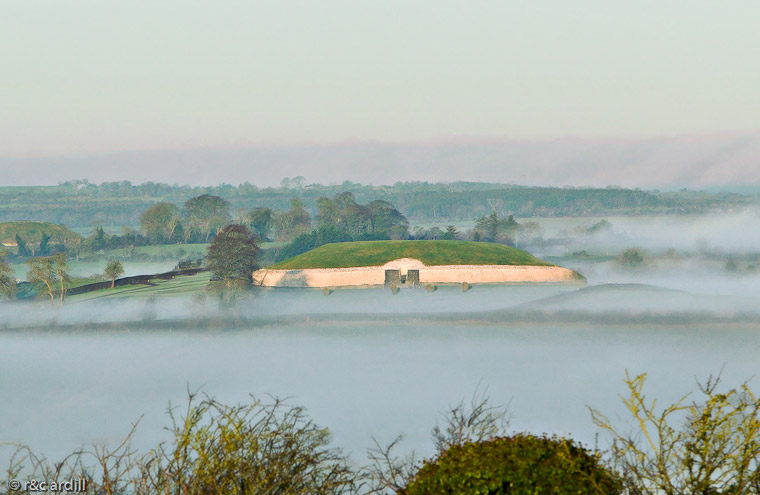

Brú na Boinne or Newgrange is a famous example of a sídhe and an entrance to the Otherworld
The Otherworld appears in very different forms, and is different in Irish literature as opposed to Welsh literature. Some features appear more than once, such as food that never vanishes, and that the time seems to pass differently for people in the Otherworld as opposed to the normal world. In Immram Brain ('The Voyage of Bran') Bran and his fellows travels to the Otherworld until one of them feels homesick. They decide to return, but they are told they musn't touch the land. Nechtan does it anyway and he turns to ashes as hundreds of years have passed and in normal time he was supposed to be dead for a long time.
In Welsh literature the Otherworld also appears like a magical hall wherein time passes very weirdly. (Branwen uerch Lyr 'Branwen daughter of Llyr').

Generally, you should be scared to get stuck in the Otherworld. If you don't watch carefully, the people from the Otherworld will bewitch you so that you will follow them and never return to your family again (as in Echtra Chonnlai, 'The adventure of Connla'), or you die when you return (as in Immram Brain 'the Voyage of Bran'). If the early medieval Celts really believed in the existence of this Otherworld, we may never be able to prove. It just appears in stories and we don't know if they perceived these stories as history or simply literature.

If you're interested in the subject I suggest you read some of this secondary literature, this is just a general introduction to the subject and by no way near a complete analysis.
'Dictionary of Celtic Mythology' by MacKillop
'The otherworld voyage in early Irish literature: an anthology of criticism' by Wooding
'Irish visions of the other-world: a contribution to the study of mediaeval visions' by Seymour
'Music and the Celtic otherworld: from Ireland to Iona' by Ralls-MacLeod
'The Celtic Otherworld' by Nutt (in Folklore Vol. 18)

That's it for now, I hope to see you again soon! 
Love,
Lian


A small bibliography (I'm still a university student..)
'Ancient Irish Tales' by Cross and Slover  
'The Mabinogion' translated by Gantz
Books and articles above

Sources photography:
Book of Kells
Robert and Cathy Ardill

maandag 10 oktober 2011

Is acher in gaíth in-nocht...

Dia dibh, (hello!)

O my god, I can't believe it's been a few months since I wrote something! I'm terribly sorry, I didn't have the time and the inspiration, but now I have enough for some more blogposts :)

So I started my second year in the BA Celtic Languages & Culture, and I love how that sounds (H) I'm loving it even more than I did last year, though I am drowning in homework and I am stressed out almost 24/7. But as I passed both stupid obligatory courses (Linguistics and Literature), I will only have to do Celtic courses! Big yay! And that means that I'm studying Old Irish now, the hardest language I have ever tried to understand, and Medieval Latin (lots of monks and saints and popes and..) and still Middle Welsh. Next to my studies there are lots of interesting things happening (lots of musicals, reviews will come), especially with Twibv! Last week we did a mini-gig at an event organized by my mother, we did two songs which was really awesome to do. And this Thursday we will play an hour in the local hospital. Awesome. So we are busy big time!!

Now, to make this blogpost somewhat more interesting, some Old Irish poems!!

This poem is found in a manuscript of Priscian's Institutiones Grammaticae, scribbled on the paper. It is probably written in the 9th century, when monasteries were often raided by the Vikings. The poem speaks about fear for such a raid.
Is acher in gaíth in-nocht
Fu-fúasna fairggae findfolt
Ní ágor reimm mora minn
Dond láechraid lainn ua Lothlind

The wind is bitter tonight
It tosses the sea's white hair
I do not fear the coursing of a quiet sea

By the fierce warriors from Lothlend


Having studied Modern Irish for a few months, I was delighted to notice some words that I recognized immediately! In-nocht is the Old Irish form for anocht, a word that's used a lot in Modern Irish (I'm going to the pub tonight! Will you be at the pub tonight?), and fairggae looks like farraige, meaning sea. I always liked that word, no idea why. It sounds mysterious ^^
But despite these things that do seem familiar, Old Irish is way more complicated than Modern Irish. The verbs are conjugated as many times as you can think of, it's really annoying if you turn a page and see moooore paradigms.. Compare:
O-I:                                                M-I
Do-biru                                           Tabhair mé
Do-bir                                             Tabhair tú
Do-beir                                           Tabhair sé/sí 
Do-beram                                       Tabhair sinn
Do-berat                                         Tabhair sibh
Do-beiraid                                       Tabhair siad
(this is actually the same verb. Explanation for those of you who would like to know: Do-beir is a so-called 'deuterotonic' form, and if you use it in a conjunct form (so after a conjunct) you would get *ní-do-beir. But 'ní' and 'do' are both unstressed, and you can't have two unstressed sounds after each other. SO the stress shifts from 'beir' to 'do', and then something unpredicatble happens: 'do-beir' changes to 'tabair'. And this is the form that survived in Modern Irish) (this is again an example why Old-Irish is annoyingly complicated)


I will write some more about Old-Irish, it's just too weird and I love it, and coming up: Reviews about Miss Saigon, John Spillane's Irish Songs We Learned At School, and some more musicrelated stuff!!


Until next time,
Slán,
Lian

maandag 6 juni 2011

Croíbhualadh

Hi guys,

My homework for tomorrow was translating an Irish poem. Normally, I'm not really a poem-person, but this one is really beautiful. The poem is by Louis de Paor, translation by me!!


Croíbhualadh (Heartbeat)


Marble rain
Is clattering on the roof,
Fingernails of anxiety
drumming
on my skull.
I can't sleep.


Behind her shut eyes,
She follows the sun
through long halls of sleep
Her stretched body
lying against me
without temptation


For a smaller distance
than the smallest distance
her breath stops
at its peak
indrawn,
a phone before ringing
a car before crashing


The wind holds a breath
and a listening ear.


The noise
of a hundred maladjusted clocks
smothers the whisper of blood
in my bruised heart


Until her chest drops
and releases
sweet burden of air
in a smothered muffler
the fear of my mouth


Happy furore bursts in my pulse,
with noise of bumpercars
on a fair day in Youghal,
a rattling of a phone
in closed exchange,
shoes of the rain
on the slate floor above me,
until the whispering of the insensible clock
wakes my clapping heart
to tell me later on
that her breath will stop
for a longer time
than eternity


the rain continues
shovelling stone above me.
Can't sleep.

Louis de Paor reads this poem in Irish: